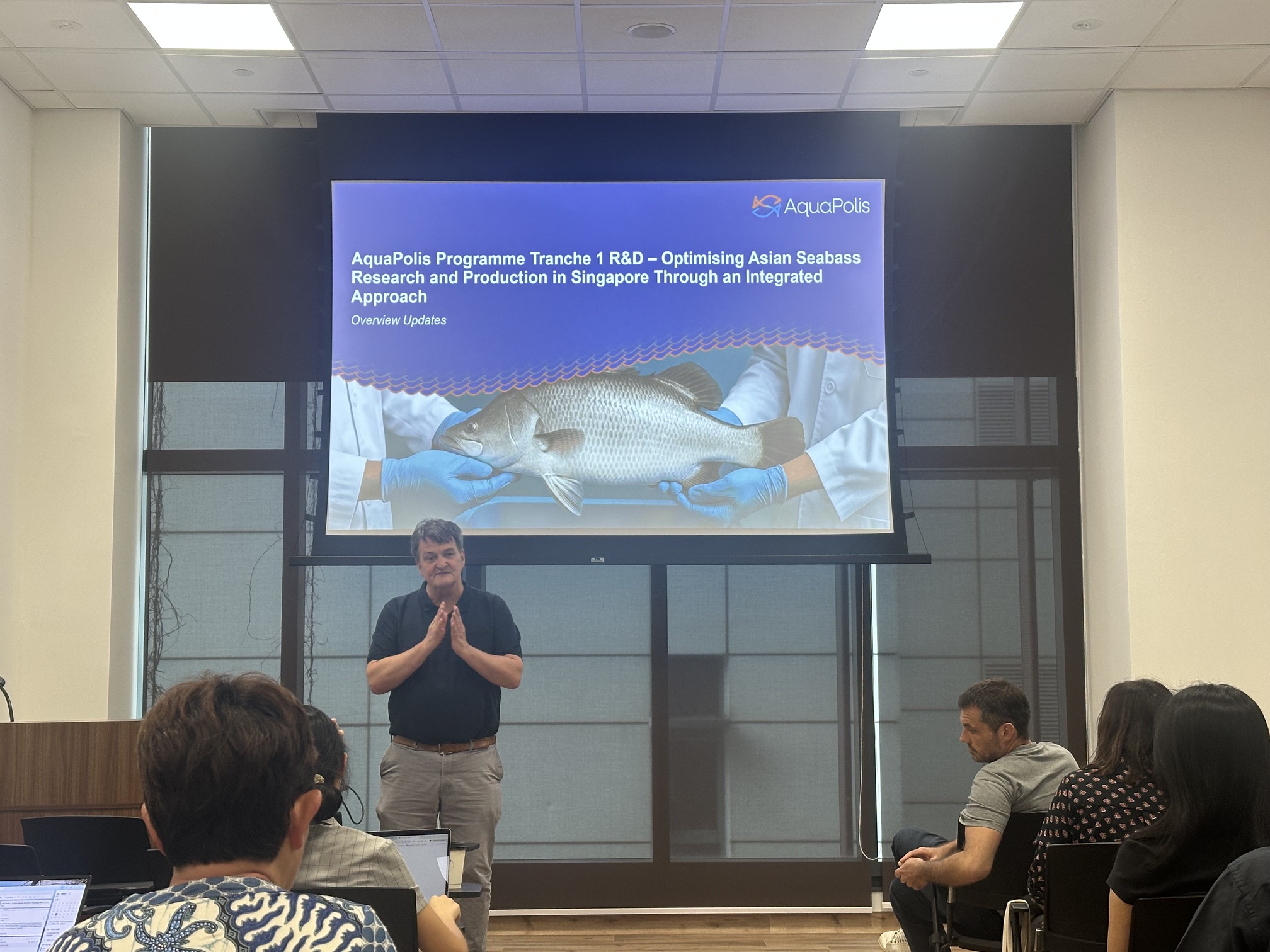
Optimising Asian seabass research and production in Singapore through an integrated approach
This multi-institution research programme unites expertise from eight Institutes of Higher Learning (IHLs) and Research Institutes (RIs) to address key production bottlenecks for Singapore’s Asian Seabass industry. Through genetics, nutrition, epidemiology and trials with farm partners, the team aims to deliver hardier fingerlings, healthier grow-out fish, and cost-effective, sustainable feeds that improve yield, quality and resilience. This programme also features strong academia-industry collaboration, highlighting the importance of translating science into the field.
At a Glance
Funding Programme: Singapore Food Story (SFS) R&D Programme 2.0
Topic: Genetics & Breeding, Health & Nutrition, Asian Seabass
Duration: November 2025 – October 2028
Consortium: 8 Institutional Partners, 19 Industry Partners
Programme Leads: Dr Richard LE BOUCHER, Temasek Life Sciences Laboratory; Dr Christoph WINKLER, National University of Singapore
The Challenge
Local Asian Seabass producers face high production costs and losses – from high mortality rates driven by parasitic and disease infections to inconsistent performance from imported fingerlings and local hatchery deformities. Limited pathogen surveillance and reliance on chemicals further strain resilience, while fillet nutrition and taste could be improved to differentiate from imports. This programme targets these bottlenecks with parasite‑resistant genetics selection, optimised broodstock diets and early feeding strategies, smarter disease monitoring and management, immune enhancement to cut chemical use, and finishing diets using local by‑products, with the goal of validating on farms to lift quality, survival, and sustainability.
Objectives
Enhance fingerling robustness and quality
Implement a genomic selection programme and Genome-wide association studies (GWAS) to improve parasite resistance
Optimise broodstock diets to improve egg and larval quality
Establish advanced early feeding strategies (nutritional programming, live feed enrichment) to reduce deformities and improve long-term feed conversion
Increase disease resistance and survival of fish during grow-out phase
Conduct farm-based epidemiological surveillance to map viruses, bacteria, and parasites, informing diagnostics, treatments and vaccines
Characterise marine parasiste life cycles, distribution, and modes of action to guide control strategies
Develop immune enhancement strategies, including evaluating potential immunostimulant and vaccine candidates
Develop feed that allows sustainable and high-quality fish production
Formulate feeds that incorporate higher proportion of local food by-products and raise fillet omega-3 levels
Validate innovations in on-farm trials to confirm performance, cost-effectiveness, and environmental benefits
Expected Results & Impact
First-in-region
Genetic selection delivering parasite-resistant tropical marine fish
Feed efficiency
Fingerling nutritional programming protocol to improve carbohydrate use and feed efficiency
Early disease forecast
A metagenomic microbiome atlas for fish and culture systems to enable early disease to forecast and suitable treatment design
Strengthening immunity
New feed additives that activate heat-shock pathways, strengthening immunity and reducing chemical reliance
Quality
A suite of finishing feeds that boost fillet nutritional quality and enhance market value
Work Packages
Enhance fingerling robustness and quality
Work Package 1.1 Genomic Selection for Parasite Resistance
Co-Leads: Dr YUE Gen Hua (TLL), Dr LIEW Woei Chang (MAC)
Work Package 1.1 will apply genomic selection, quantitative selection, and selective breeding techniques to develop parasite-resistant fish strains. It is expected to contribute to reducing fish mortality rates at grow-out farms resulting from parasite and secondary infections.
Objectives: Genetically select fish with increased resistance to parasites and enhance understanding of host-parasite interactions.
Work Package 1.2 Optimising Egg and Larval Quality
Co-Leads: Dr Rui A. GONCALVES (MAC); Dr Richard LE BOUCHER (TLL)
Work Package 1.2 will focus on optimizing Asian seabass broodstock nutrition and immunity via tailored diet formulations, screening feeds for endocrine disruptors, and testing functional additives to improve lipid use and mitigate oxidative stress and inflammation. It is expected to contribute to reducing fish mortality rates at grow-out farms resulting from inadequate broodstock health, poor maturation, and weak juveniles.
Objectives: Enhance broodstock health, improve maturation and spawning management, and advance husbandry practices to produce more, hardier juveniles
Work Package 1.3 Advanced Early Feeding Strategies for Fingerling
Co-Leads: Dr Christoph WINKLER (NUS); Dr Caroline Lei WEE (A*STAR IMCB)
Work Package 1.3 will focus on developing early dietary interventions to reduce deformities (with emphasis on opercular abnormalities) and programme juvenile metabolism toward efficient carbohydrate use, using a multiomics framework to assess genetics, epigenetic, and cellular impacts on skeletal growth and bone remodeling. It is expected to contribute to reducing fish mortality rates at grow-out farms resulting from poor quality juveniles.
Increase disease resistance and survival of fish during grow-out phase
Work Package 2.1 Tracing Pathogen Trends: A Comprehensive Farm Epidemiological Survey
Lead: Dr Stefan OEHLERS (A*STAR IDL)
Work Package 2.1 will focus on establishing an epidemiological surveillance programme across three sentinel farms to build a pathogen sample library and map outbreak origin, seasonality, prevalence, and severity to improve preparedness for future disease outbreaks. Pathogens will also be characterized for diagnostics, management and downstream vaccine R&D. It is expected to contribute to reducing fish mortality rates at grow-out farms resulting from diseases.
Objectives: Pinpoint and characterize pathogens driving farm mortalities
Work Package 2.2 Combatting Marine Parasites
Lead: Dr Susan GIBSON-KUEH (JCUS TFI)
Work Package 2.2 will focus on collecting and analyzing parasite populations from farms across Singapore to resolve genotypes, life cycles, host interactions, and environmental drivers (salinity, temperature), and map seasonal distribution using data collected from Work Package 2.1. It will also focus on evaluating alternative environmentally safer treatments to reduce reliance on formalin and copper. It is expected to contribute to reducing fish mortality rates at grow-out farms resulting from parasite infections.
Objectives: Identify and characterize parasites causing mortalities, and deliver effective, environmentally safer treatments and management strategies for farms
Work Package 2.3 Innovations in Immune Enhancement Strategies for Sustainable Aquaculture
Co-Leads: Dr Steven FONG (NUS); Dr Richard LE BOUCHER (TLL); Dr Joachim LOO (NTU)
Work Package 2.3 will focus on evaluating vaccine efficacy and testing immunostimulants (e.g. seaweeds, chitin, yeast lysate) in controlled disease challenges against the Scale Drop Disease Virus (SDDV). It is expected to contribute to reducing fish mortality rates at grow-out farms resulting from disease outbreaks.
Objectives: Evaluate and identify approaches for immune enhancement
Develop feed that allows sustainable and high-quality fish production
Work Package 3 Grow-out feed innovations for Sustainable and High-Quality Fish Production
Lead: Dr Richard LE BOUCHER (TLL)
Work Package 3 will focus on developing a dual-feed nutrition strategy centered on Finishing Feeds for the final grow-out period to elevate fillet omega-3, iodine, and vitamin content and enhance flavour, validated through sensory testing. Formulations will prioritise sustainability and cost reduction by lowering fishmeal use and incorporating local by-products and alternative proteins (e.g. single-cell protein from food side streams). It is expected to contribute to increasing competitive advantage over imported fish through nutritional enhancement and sustainability.
Objectives: Boost nutritional value of locally farmed fish while improving their sustainability footprint through greater use of local by-products in aquafeeds